

Facebook ads used to be a targeting game. You picked a few zip codes, stacked up interests like “homeowners” and “new parents,” and hoped the right people scrolled past your ad.
That game is mostly over. Meta spent the last two years rebuilding the system that decides who sees which ad, and in 2026 it kept going: new AI ranking models, tools that turn your photos into video ads, and an assistant inside Ads Manager that’s being tested to build campaigns when you ask. Most of it reaches your account automatically, whether you touch anything or not.
This is the fourth post in our 2027 series, after Google Ads, video marketing and SEO. Same rules. We only cover changes Meta has announced itself. Everything else is what we’d do with Facebook ads and Instagram ads next year if it were our own money on the line. Advice, not predictions.
What actually changed with Meta ads in 2026
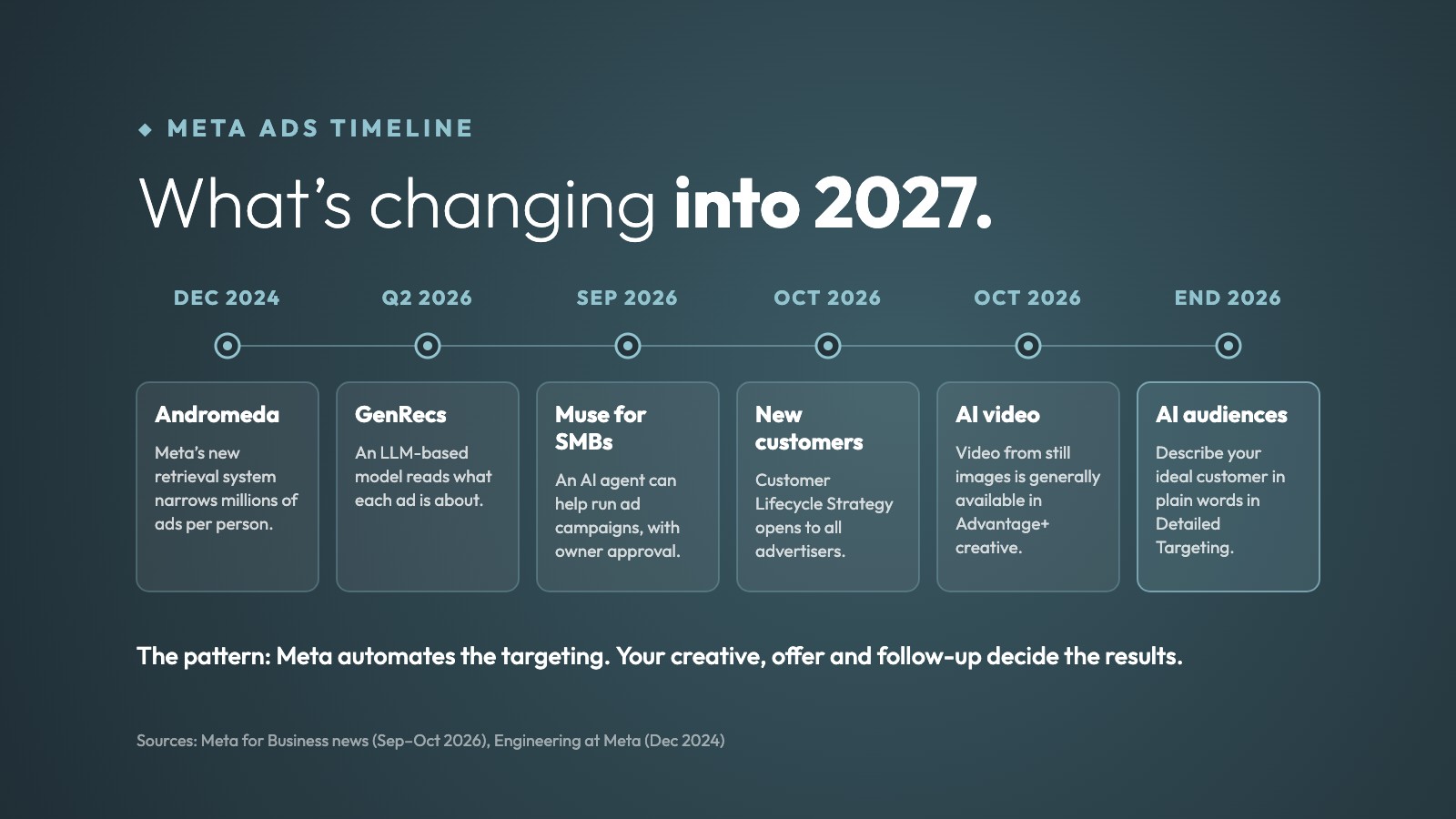
Here’s the short version, pulled from Meta’s own announcements:
- Meta’s retrieval system, Andromeda, narrows tens of millions of ads down to a few thousand worth ranking for each person. Meta kept upgrading it this year and added a model called GenRecs that uses large language models to understand what your ad is actually about. Meta explains the whole setup in how its ads system matches your ad to the right person.
- Ad quality now openly includes what happens after the click: people who hide your ads, feel misled, or get hit with surprise charges.
- In October, Meta opened Customer Lifecycle Strategy to every advertiser, so you can tell a campaign it’s meant for new customers.
- Turning existing still images into video is now generally available in Advantage+ creative.
- AI audience discovery, where you describe your ideal customer in plain words, is due in Detailed Targeting by the end of 2026.
- Meta is testing an Ads Manager assistant that can plan campaigns, change budgets and update targeting by request, and in September it launched Muse for Small Business, an AI agent that can help run ad campaigns with the owner’s approval. Both are covered in Meta’s Advertising Week New York 2026 announcement.
See the pattern? Meta keeps taking jobs away from the person setting up the campaign. Targeting, placements, even the creative. What’s left for you is the stuff the machine can’t guess.
So here are the seven moves we’d make.
1. Give your Facebook ads more creative to work with
Meta’s own advice for 2026 is to “supply more creative variety so the system has more to test.” With Andromeda, the creative in your Facebook ads does a lot of the targeting. A different angle reaches a different kind of person.
For a local business, that doesn’t mean forty versions of the same coupon with a new background color. It means genuinely different ideas. A roofer in Stone Oak could run one ad showing the crew tearing off old shingles, one with the owner explaining what a storm inspection includes, and one simple shot of a finished roof with a clear offer. Three very different reasons to stop scrolling.
The AI video tools can fill gaps. We’d still put real footage of your real people at the center. If every plumber in town lets Meta animate the same stock-looking photo, the ad with an actual tech standing in an actual San Antonio kitchen is the one that looks different.
2. Tell Meta what a good customer is worth
Meta puts it bluntly: “A lead isn’t a sale.” The system optimizes for exactly what you tell it to, and nothing else.
The most common mistake we see with local Facebook ads is optimizing for the cheapest form fill. You get a pile of names, and half of them never pick up the phone. Pick the action closest to real money that you can actually track. A phone call. A booked appointment. A lead your team marked as qualified.
Then, if you can, send that information back. Most CRMs can pass lead outcomes to Meta through the Conversions API. A dental office near the Medical Center knows a cleaning and an implant consult aren’t worth the same, and Meta’s value settings let you say so.
3. Run fewer campaigns, then leave them alone
This one surprises people. In its peak season guidance, Meta says each ad set needs roughly fifty conversions a week to learn properly. Below that, in Meta’s words, the system is guessing.
Meta even gives a formula: weekly budget divided by (cost per result × 50) equals the most ad sets your budget can support. Plug in a made-up example. A family restaurant on the North Side spending $500 a week at $20 per lead gets 0.5. That’s half of one ad set.
Most small Facebook ads accounts will never hit fifty a week, and that’s fine. It just means you shouldn’t split a modest budget across six campaigns. One campaign, one or two ad sets, lots of creative.
And stop editing every few days. Meta’s point is that every change restarts the learning, so group your changes and make them all at once.
4. Keep new customers and old ones apart
Plenty of “great” Facebook ads results are really people who were going to buy from you anyway. Your regulars see the ad, come in, and the report takes credit.
Customer Lifecycle Strategy, now open to all advertisers, lets you mark a campaign as being about finding new customers and suggests excluding your existing ones. For an HVAC company with a few thousand past customers, upload that list and keep your prospecting budget pointed at people who’ve never called you.
Then use separate Facebook ads to talk to your past customers and website visitors, with a smaller budget and a different message. We cover how in our post on retargeting ads for San Antonio businesses.
5. Fix what happens after someone taps your Facebook ad
Meta says ad quality “reflects the whole customer experience, including what happens after the click.” It looks at feedback from people who hide ads and surveys people about whether they felt misled.
So the page your ad sends people to isn’t a separate project anymore. If the ad says “same-week appointments” and the landing page says nothing about it, that’s a problem. Same if the page takes eight seconds to load on a phone, or the form wants eleven fields.
Before you spend another dollar, tap your own ad on your own phone. Does the page match the ad? Is there one obvious next step? If someone calls at 4:45 on a Friday, does a person answer?
6. Use the AI assistants, but keep your hands on the wheel
The new assistant features and Muse for Small Business will be tempting, especially for owners who don’t love managing Facebook ads by hand. Honestly, they’re good at grunt work: weekly summaries, budget reminders, first drafts of ad copy.
But remember who built them. Meta’s assistant is designed to get results inside Meta’s auction. It isn’t going to tell you that your next $1,000 would do more in Google Ads, or that your website is the real bottleneck.
Meta says previews and approvals let you decide what to hand off. Use them. Our rule would be simple: no new campaign and no budget change goes live without a human looking at it. And read every AI-written headline before it runs, especially if you’re in law, healthcare or another field with its own advertising rules.
7. Judge Facebook ads on real business results
Meta draws an important line itself: platform-reported results show what happened, while a lift study shows what happened because of your ads. Those can be very different numbers.
Lift studies need a decent budget, so most local businesses will do something rougher. Track calls. Ask every new customer how they found you. Hold a campaign steady for a full month and compare booked jobs, not clicks. If you run Google Ads too, line the two up side by side, the way we described in our Google Ads strategies for 2027 post.
Cost per real lead, booked jobs and revenue. If your Facebook ads report can’t tie back to those, fix the tracking before you raise the budget.
Where Facebook ads fit in a San Antonio plan for 2027
Facebook and Instagram are where people find you before they know they need you. Google is where they look once they do. A good website closes the deal either way.
That’s why we’d never run Facebook ads by themselves. They work best with real video feeding the creative, a website that matches the ad, and retargeting that follows up. Our video marketing strategies for 2027 post covers the video side.
At Gova Creative, we help San Antonio businesses put those pieces together. Our digital marketing team runs Meta ads, Google Ads and retargeting, our video production crew shoots the real footage your ads need, and our website design team builds pages that turn those clicks into calls. If you want a second set of eyes on your 2027 Meta ads plan, book a Discovery Call.


Want help putting this to work?
One team for your website, videos, ads and brand, built as one plan. Let’s talk about your goals.
Book a Discovery Call 30 minutes · Real answers · No sales pitch