

Video marketing for most local businesses used to mean one nice video on the homepage and a YouTube channel that hadn’t been touched since it went up. That still beats nothing. But the platforms people actually watch on have changed a lot in the last two years, and a few of those changes matter more for a small business in San Antonio than all the “go viral” advice put together.
So this is the next post in our 2027 series. These are the video marketing strategies we’d focus on going into next year, based on what YouTube, Facebook, Instagram and Google have really changed. No predictions dressed up as facts. Just what we’d do if it were our business.
What Changed in Video Marketing Over the Last Two Years
Quick recap before the strategy part, because good video marketing only makes sense once you see the pattern.
In October 2024, YouTube started letting people upload Shorts up to three minutes long (YouTube’s announcement). Instagram raised its Reels limit to three minutes a few months later.
In April 2025, Instagram launched Edits, its own free video editing app for phones.
In June 2025, Meta said that all videos on Facebook would be shared as reels, with no length or format restrictions. There’s no more choosing between “video” and “reel.” It’s one format now.
Then the originality push. In July 2025, Facebook announced it would cut distribution for accounts that keep reposting other people’s content. Instagram applied a similar rule to photos and carousels this April, after doing it for reels in 2024. And on October 1, 2026, YouTube said it’s updating recommendations to favor original Shorts and reduce reach for channels that mostly re-upload other creators’ clips (Search Engine Journal’s write-up).
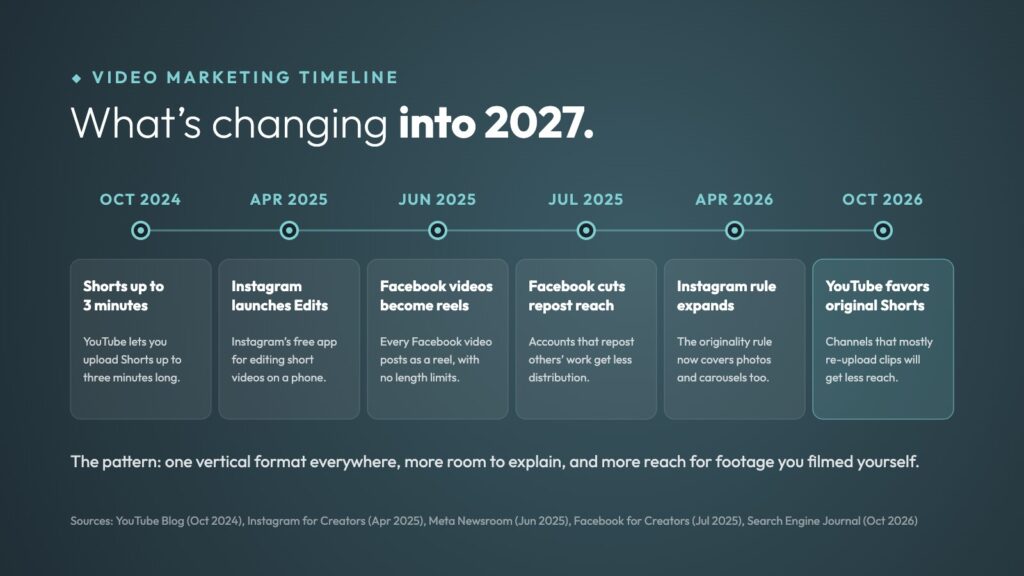
Put those together and the direction is pretty clear. Short vertical video is the default everywhere, the length limits got looser, and the platforms are rewarding people who film their own stuff.
That’s good news for video marketing at a local business. You already have something nobody else can repost: your shop, your crew, your patients’ questions, your actual work.
1. Stop Treating “Real Videos” and “Social Clips” as Separate Projects
A lot of business owners still think of video in two buckets. There’s the expensive brand video, and then there’s the stuff somebody shoots on a phone for Instagram.
Facebook basically erased that line when it folded every video into reels. A two-minute clip of your HVAC tech walking through a system check lives in the same place as a 20-second teaser. Same viewer, same feed.
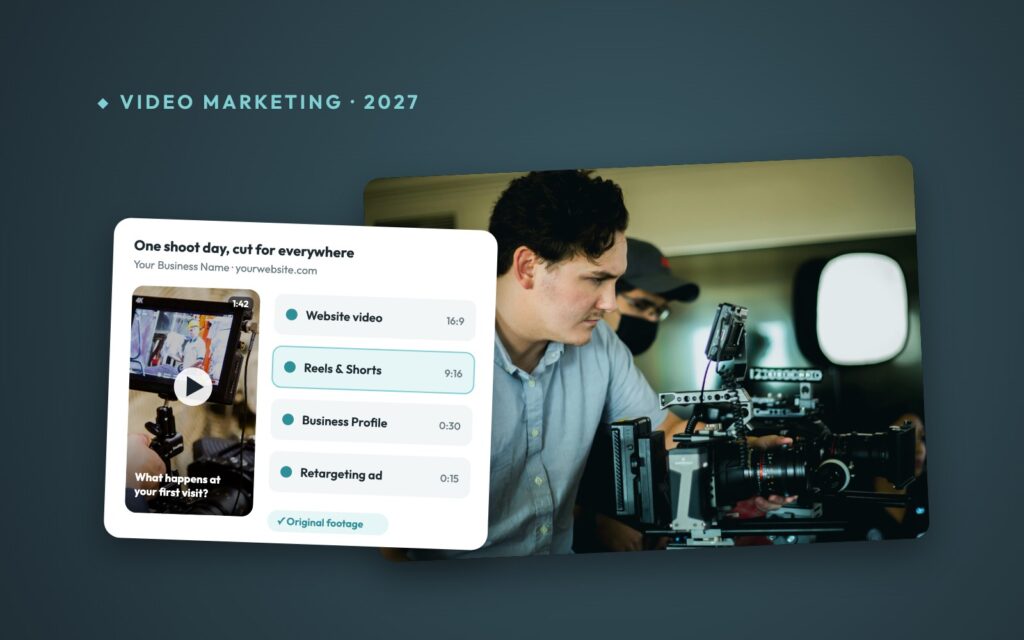
So plan them together. When we film a brand video for a client, we’re also thinking about the vertical cuts, the 30-second version, the clip that answers one question. One shoot. Many pieces. That’s the most practical video marketing change most small businesses can make in 2027, and it usually saves money instead of costing more.
2. Make Original Footage the Backbone of Your Video Marketing Strategy
Every major platform is now saying the same thing in different words: original content gets the reach, recycled content gets less.
For most local businesses this isn’t a threat. You weren’t building a clip channel. But we do see a smaller version of the problem. Somebody grabs a trending video, slaps their logo on it, and posts it. Or they run the same stock-footage template every other company in their industry uses.
That kind of video marketing was never great. Going forward we’d expect it to get even less traction.
What works better is boring in the best way. A roofer in Stone Oak filming the actual hail damage on a real roof (with the homeowner’s permission). A dental office near the Medical Center showing what the first visit looks like, walking from the front desk to the chair. A family restaurant on the North Side showing the brisket coming off the pit at 6 a.m.
Nobody else can post that. That’s the point.
3. Use the Extra Time, but Earn It in the First Few Seconds
Three minutes on Shorts and Reels is a lot of room. Most local businesses in San Antonio don’t need all of it.
We like the longer limit for one kind of video: the explainer. “What happens during a foundation inspection.” “How we price a kitchen remodel.” “What to bring to your first appointment.” Those used to get chopped into awkward 60-second pieces. Now they can breathe.
But the first few seconds still decide whether anyone sticks around. Open with the question or the problem, on screen and out loud. Skip the logo animation. Skip “Hey guys, welcome back.”
And add captions. Plenty of people scroll with the sound off, and a clip that makes no sense muted is a clip they skip.
4. Put Your Video Marketing Where Buyers Already Look
Social reach is nice. But a lot of the money in video marketing for local businesses sits in two less exciting places.
Your website
Someone who lands on your service page is already shopping. A short video of the owner explaining how you work, or a real walkthrough of a finished job, answers the “can I trust these people?” question faster than another paragraph of copy. Put it near the top of the page, near the call button, not buried at the bottom. (If your site gets visits but not calls, we wrote about what to fix first.)
Your Google Business Profile
Google lets you add videos to your Business Profile, and its help page lists the specs: up to 30 seconds, up to 75 MB, 720p or higher. That’s a perfect home for the short cuts from your bigger shoot. A 20-second look inside your showroom or your service bay gives someone comparing three businesses on Google Maps a reason to pick you.
5. Film Once, Cut Many: A Simple Shoot-Day Plan
This is where most video marketing falls apart for small businesses. Not the ideas. The follow-through. Somebody films a little here and there, it never adds up to much, and by March the account has gone quiet.
A planned shoot day fixes most of that. Here’s roughly how we’d structure one for, say, a manufacturer out by the East Side or a law office downtown:
- Write down the 8 to 10 questions customers ask most before they buy.
- Film the owner or a key person answering each one on camera, in a real setting, not a blank wall.
- Grab plenty of b-roll: hands working, the team, the building, the product, the finished job.
- Shoot a few moments horizontally for the website and YouTube, and the rest vertically for Shorts, Reels and your Business Profile.
- Cut it into a month or two of posts, plus one or two longer pieces for your site.
You don’t need fancy gear for every piece. Phones and free tools like Edits are fine for quick updates. But the anchor pieces, the ones that live on your homepage and in your ads, are worth doing properly. Bad audio is still the fastest way to look less trustworthy than you are.
6. Give Every Video a Job (and Connect It to Your Ads)
The last strategy is the one we’d push hardest. Every piece of video marketing should have a reason to exist.
Some videos are there to introduce you to people who’ve never heard of you. Some answer objections for people who are comparing you. Some are there to bring back visitors who looked at your site and left. That last group is where video and ads work really well together. Someone who watched most of your “how we work” video is a warm prospect, and Meta’s ad tools let you show them a follow-up ad later. We covered how that works in our post on retargeting ads.
The same footage can feed your Google Ads too. We wrote about where Google is heading in our Google Ads strategies for 2027 post.
If a video doesn’t have a job, it’s probably a video you don’t need to make yet. That one rule will keep your video marketing budget pointed at customers instead of vanity views.
What We’d Skip in 2027
Chasing trends that don’t fit your business. A plumber doing a dance trend gets a laugh, maybe. It rarely gets a call.
Paying for a big one-off brand film with no plan to cut it down. That’s a lot of budget sitting on one page.
Posting the same clip, untouched, to every platform the same day and calling it a strategy. It’s fine as a starting point. It’s not the whole plan.
None of these video marketing strategies require a huge budget. They mostly require a plan, real footage of your real business, and somebody making sure it actually ends up where customers look.
At Gova Creative, our San Antonio video production team plans and shoots video that’s built to be cut into dozens of useful pieces. Then we put it to work on websites built to turn visitors into calls, and back it with Google Ads and Meta ads that reach the right people. If you want help mapping out your video plan for 2027, book a Discovery Call with us.


Want help putting this to work?
One team for your website, videos, ads and brand, built as one plan. Let’s talk about your goals.
Book a Discovery Call 30 minutes · Real answers · No sales pitch